The Radicals Have Checked In: How Collectible Design Redefined the New Luxury Hotel

There was a time when luxury could be quantified by a formula: a precise thread count, a specific grade of Italian marble, a predictable arrangement of mid-century modern armchairs, and a safely abstract corporate canvas hung neatly behind the reception desk.
For decades, this was the international shorthand for high-end hospitality.
It was premium. It was elegant. And it has completely lost its power.
Today, global luxury real estate and hospitality are undergoing a profound spatial realignment. The modern cultural traveler no longer seeks shelter; they seek authorship.
In an era where generic minimalism can be replicated at scale, premium hospitality operators are realizing that safe interiors result in anonymous brands. To command top-tier rates and foster genuine cultural reverence, a space must possess an opinion. It needs an emotional anchor.
Hotels are aggressively evolving into living fine art galleries—and the boundary between structural utility and collectible design has completely dissolved.

The Spatial Psychology of the Narrative Object
The shift toward art-driven hospitality is not merely aesthetic; it is deeply rooted in the commercial psychology of architectural design. Data consistently reveals that professionally curated, museum-quality environments increase guest dwell time in public zones like lobbies, bars, and lounges by over 20%. When guests linger, they engage. They absorb the atmosphere, they document their experience, and they drive food and beverage revenue.
But hanging art on a wall is no longer enough. A painting remains a passive element—a window to be looked at. The real breakthrough happens when art becomes structural, interactive, and spatial.
This is the playground of collectible furniture design, a market segment that has outpaced several traditional fine art categories in recent years. By introducing functional sculptures into the architectural layout, designers solve two critical problems simultaneously: they fulfill the functional requirements of a floor plan while establishing the artistic identity of the envelope.
Unlike a fragile canvas, a piece of art-focused furniture can be touched, inhabited, and integrated into the human experience. It transforms a spectator into a participant. Across Asia's design capitals, forward-thinking operators are deploying high-authorial furniture and monumental art to break the typical hospitality template.

Mondrian Singapore Duxton
Brought to life by DP Architects and Los Angeles-based Studio Carter, this property is a masterclass in deconstructed hospitality, intentionally discarding the quiet corporate lobby template to immerse visitors immediately in a high-energy art canvas.
The Design Strategy: The arrival sequence drops guests straight into a bustling restaurant and lounge envelope rather than a transactional reception desk. The design language deconstructs the traditional Singaporean shophouse—contrasting raw, textural plaster walls and deep copper arches against sharp, contemporary glass structures.
The Art-Furniture Integration: Partnering with premier advisors The Artling, Mondrian integrated a multi-million dollar permanent contemporary art program directly into the building's blueprint. Anchored by a monumental, site-specific outdoor KAWS sculpture at the gateway, the interior spaces utilize wavy custom mirrors, graphic ceiling murals, and highly expressive, standalone seating installations. The furniture operates as an element of visual surprise, maximizing dwell time and transforming functional hospitality zones into cultural destinations.

Sky Beach, the al fresco rooftop bar at The Standard, Bangkok Mahanakhon
The Standard, Bangkok Mahanakhon
Designed by legendary Spanish artist-designer Jaime Hayon in collaboration with The Standard's in-house team, this flagship property is a vibrant manifesto for sculptural surrealism and expressive furniture geometry.
The Design Strategy: The entire hotel functions as a live showroom for fluid forms and bold color-blocking. Rather than setting up standard commercial seating layouts, the spaces are intentionally curated to feel like an interactive gallery.
The Art-Furniture Integration: The public lounges, tea rooms, and lobbies are completely populated by Hayon’s signature anthropomorphic furniture profiles and custom handcrafted ceramic fixtures. By blending his distinct curvilinear silhouettes (deeply tied to the experimental spirit of brands like BD Barcelona) directly into the floor plan, the hotel turns simple hospitality zones into high-visibility conversational destinations.
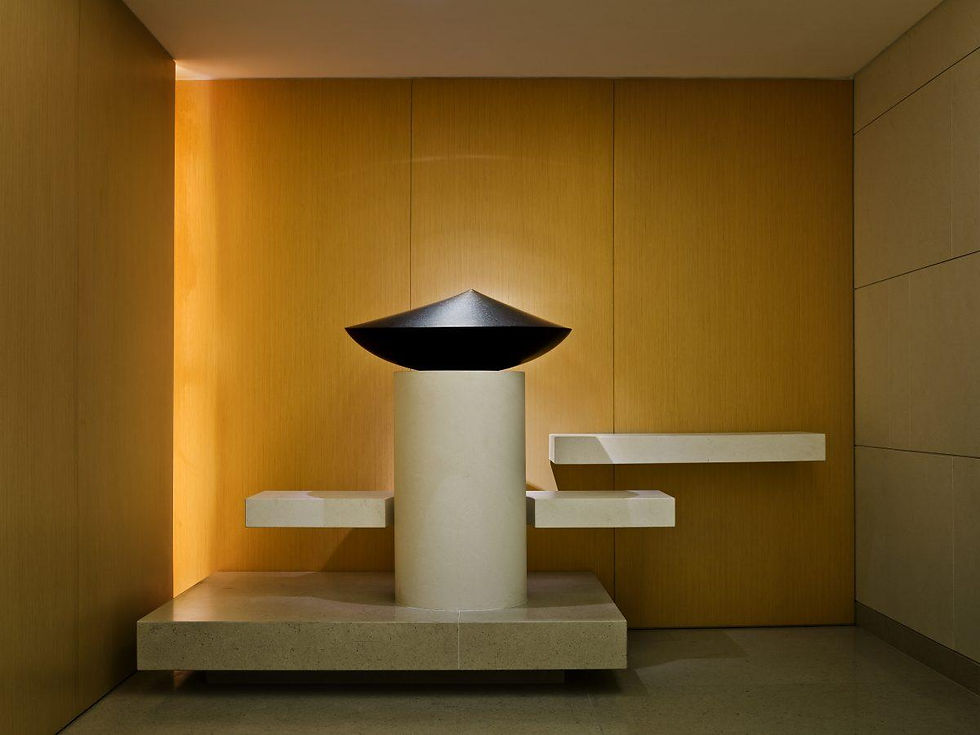
Artist Armen Agop’s granite work Silence as seen off the Level 6 Lift.
Upper House Hong Kong
Designed by world-renowned architect André Fu, this property is a masterclass in understated luxury, structured to feel like the private sanctuary of an elite design collector.
The Design Strategy: Fu avoids typical corporate hospitality tropes, using a serene, monochromatic layout that relies entirely on material texture, proportion, and finely framed views.
The Art-Furniture Integration: The hotel’s entire spatial flow is built around a multi-million dollar collection of custom-commissioned contemporary sculptures made of bronze, sandstone, and Italian marble. Every lounge area, corridor, and elevator landing is architecturally configured to spotlight these radical, standalone works of art—proving how furniture arrangements and fine sculpture must work in perfect unison to establish a property's cultural authority.
The Radicals: Anchoring the Architectural Envelope
At Objective, we look at furniture through the lens of architectural specification and historic provenance. When selecting pieces that must carry a room, three historic lineages stand entirely apart, offering the perfect intersection of cultural cachet and structural utility.

1. BD Barcelona: The Poetic High-Performance System
BD Barcelona occupies a singular niche where technical engineering meets poetic, expressive silhouettes. Rejecting mass production in favor of artisanal avant-garde processes, the studio bridges historic genius—faithfully reproducing the surrealist visions of Salvador Dalí and the organic structures of Antoni Gaudí—with contemporary masters like Jaime Hayon and Konstantin Grcic.
For architects and project specifiers, BD Barcelona is a powerhouse. Pieces like the Showtime collection or the structurally brilliant, extruded aluminum Table B offer high-performance engineering hidden behind bold, authorial forms. They handle the rigorous demands of high-traffic commercial spaces while offering the visual weight of a custom gallery installation.

2. Gufram: The Trophy Object
Founded in 1966 during the height of the Italian Radical Design movement, Gufram subverted industrial design by treating molded polyurethane foam as a fine art medium. Icons like the Cactus, the Bocca lips sofa, and the chaotic Pratone lounge are not mere seating options; they are pop-art monuments.
Through exclusive lines like Supergufram, the brand targets high-visibility public zones, luxury boutique lobbies, and fashion retail flagships. These are conversational "trophy objects." A single Gufram piece completely alters the energy of a room, instantly creating an iconic, highly documented destination within a property.

3. Poltronova: Archival Postmodernism
As the historic incubator for design revolutionaries like Archizoom and Superstudio, Poltronova represents pure design defiance. Their production line holds pieces that are cross-generational cultural status symbols—most notably Ettore Sottsass’s glowing, neon-rimmed Ultrafragola mirror and the Joe baseball glove lounge chair.
Poltronova appeals intensely to style-conscious affluent buyers and boutique hoteliers who want to inject a sense of cult cultural relevance into their spaces. The Ultrafragola, casting its ambient pink waves across a room, acts less like a mirror and more like a site-specific light installation that anchors the visual rhythm of an entire interior.

The Material Renaissance: Appreciating Assets vs. Depreciating Fixtures
From a development perspective, the shift toward collectible design represents a critical evolution in procurement strategy. Standard commercial furniture is an operational expense; it begins to depreciate the moment it is unboxed.
Conversely, sourcing works from BD Barcelona, Gufram, or Poltronova is an investment in an appreciating asset class. These are investment-grade masterworks with documented provenance. They retain and often increase their value over time, optimizing the long-term asset valuation of the real estate itself.
The future of luxury hospitality belongs to spaces that refuse to be invisible. By replacing predictable layouts with radical, expressive forms, forward-thinking hoteliers are turning their properties into living cultural institutions. They aren't just designing spaces to stay—they are building spaces that hold the room.
These high-profile case studies prove that the modern Asian market is highly receptive to environments that treat functional furniture as collectible art. Whether it is specifying the poetic, expressive silhouettes of Jaime Hayon for BD Barcelona, or integrating the iconic, pop-art statements of Gufram and Poltronova into a luxury hospitality development, these pieces give architects and specifiers the leverage needed to turn a commercial space into an unforgettable landmark.
At Objective, we specialize in market placement, retail entry, and architectural specification for international design brands across the region. We provide architects, interior designers, and hospitality developers with the technical digital assets—including comprehensive BIM and Revit models—and curatorial expertise required to seamlessly integrate these iconic systems into project blueprints.
To explore our portfolio or coordinate a regional strategy consultation, contact us at letsgo@objective.rocks


Comments